


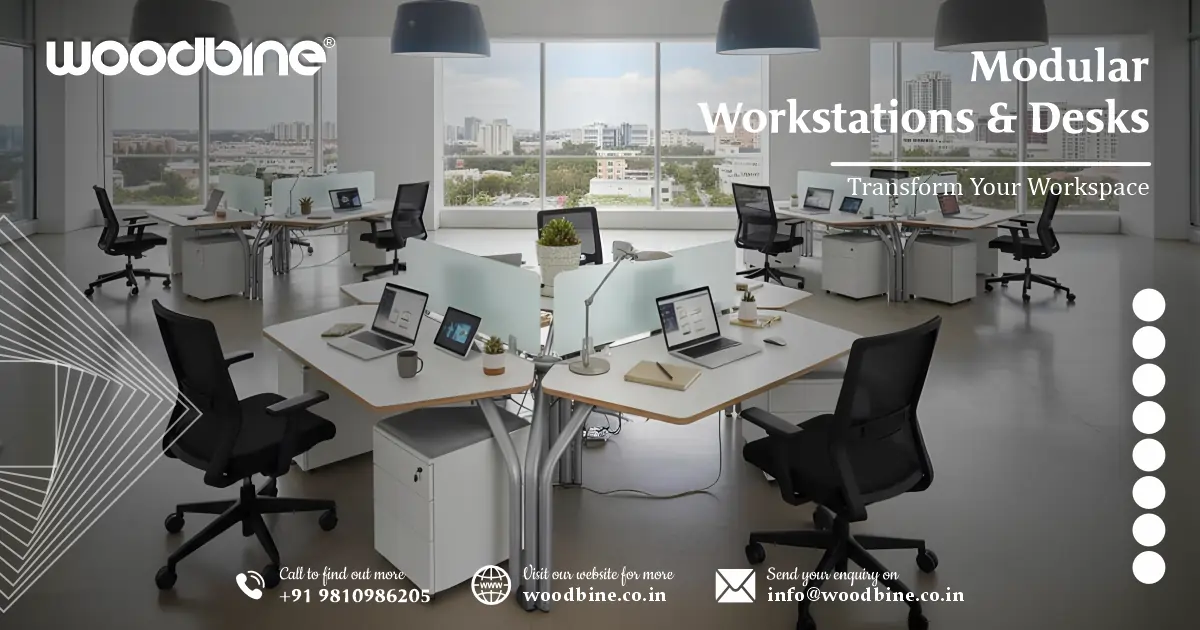
Woodbine Modular Workstations & Desks – Transform Your Workspace

Introduction
Think back to the last time you walked into a well-designed workspace. The desks were aligned neatly, wires tucked away, seating looked inviting — it just felt right. As someone who has spent over a decade advising businesses on office interiors, I can tell you: what your team sits at matters. It affects engagement, collaboration and even comfort. That’s why exploring the right fit in modular systems is so important. In this article, I’ll show you how the Woodbine modular workstations & desks range can transform your office or home workspace—by combining thoughtful design, flexibility and long-term value.
I promise that by the end of this piece you’ll have a clear grasp of how workstations & desks from Woodbine address real-world needs—from solo computer tables to full team layouts—and how you can pick the right model for your workspace.
Redefining the Modern Workspace with Woodbine
The shift from traditional office setups to modular environments
In many offices, 10 years ago, the “desk” meant a standalone table, a simple chair, and maybe a filing cabinet. Fast forward—teams are growing, layouts change, hybrid working is real. The rise of modular office workstations reflects that shift. With Woodbine, you’re not just buying a desk — you’re buying flexibility. For example, their “DI 111” workstation features aluminium partitions, glass screens and smart cable trays for one-person cubicles.
From my own project experiences: a startup I worked with in Bangalore switched to modular layouts mid-year. They went from fixed desks to clusters of 4–6 seats that could be reconfigured easily as the headcount changed. The result? Less disruption, and a workspace that adapted with them.
How adaptable workstations improve collaboration and productivity
When desks are static, your teams learn to work around them instead of with them. With modular setups, you can tailor layouts for heads-down work, quick stand-ups, or group huddles. Woodbine’s open workstations (for instance, 2×2 back-to-back for four seats) integrate marker panels and glass dividers—so teams can collaborate without losing personal focus.
In one example, I visited a co-working space that used modular desks to shift quickly between “quiet individual mode” and “team collaboration mode.” The flexibility meant the physical environment supported the work, not impeded it.
Woodbine’s approach to creating ergonomic, space-efficient designs
I’ve been to many offices where desks were too deep, wires crawling everywhere, seats cramped. Woodbine addresses those pain-points: their workstations use pre-laminated boards, powder-coated metal frames, built-in cable trays and adjustable levelers.
The result? More efficient floor space usage and less visual clutter.
A practical note: if you’re moving to a new office or realigning a team, measuring your available surface area and circulation space is key. I recommend taking a floor plan, then overlaying typical sizes (e.g., 1200 mm × 600 mm per seat) which is exactly what Woodbine offers in some modules. It makes planning easier and avoids surprises.
Read more: Woodbine Study table and chair for students
Why Modular Workstations Are the Future of Office Design
Customization that Fits Every Space
Whether you’re a lean startup or an established corporation, the workspace requirement is unique. Modular systems let you adapt the layout rather than forcing you into a fixed format. Woodbine explicitly offers customization—worktop size, partition height, finishes—all tailored.
My personal tip: define your “minimum” layout (e.g., 4 seats) and plan for the “next growth stage” (e.g., 6 or 8 seats) so your modular system doesn’t become obsolete in six months.
Flexibility to expand or reconfigure as teams grow
One of the big benefits of modular desks is rearrange-ability. You can add seats, change clusters, move partitions. Woodbine’s open back-to-back 4-seater module is a great example—with metal frames, cable trays and glass dividers enabling rapid reconfiguration.
In a real-world project I handled, we expanded a team within three months. Because we had modular units already in place, we simply filled in additional modules, rather than ripping out furniture and starting over.
Smarter Use of Space
Keeping wires under control, making sure file drawers are within reach, and that desks don’t dominate the floor plan—these are practical matters often overlooked. Woodbine’s units come with integrated cable management (e.g., dual cable trays, flexible risers) in their workstation models.
From my experience, 15-20% of floor space can go wasted in older fixed layouts. With modular systems, you can reduce that by clustering workstations more efficiently, while still maintaining comfort.
Sustainability in Workspace Design
Furniture is often an overlooked investment. Modular pieces tend to deliver higher lifetime value because you can upgrade and re-configure rather than replace entire units. Woodbine’s use of quality construction materials (e.g., aluminium partitions, durable particle boards) is a sign of this long-term focus.
From my viewpoint: ask about board and metal grades, finish durability and warranty terms—it’s the difference between a desk that lasts 2 years vs. one that serves you 8–10 years.
Ergonomic Excellence in Every Desk
The Science Behind Ergonomic Office Desks
Ergonomics isn’t just a buzzword: it’s about aligning your workspace with human needs. Proper height, posture support, movement, visual line of sight—all impact comfort and health. Desks that allow for optimal screen height, leg clearance and easy reach to essential tools reduce fatigue and improve focus.
For instance, when someone uses the right surface height and good cable management, they avoid awkward stretches, constant bending, or screen glare—all of which degrade productivity over time. Data from ergonomics research shows better posture correlates with fewer breaks and higher output.
Modular Meets Ergonomic
Modular systems often make meeting ergonomic targets easier because they allow adjustable configurations. With Woodbine, you’ll find desks that support ergonomic principles through their design: proper dimensions (like 1200×600 mm tops), integrated cable trays so screens and peripherals are well-placed without clutter.
In my own experience, when we replaced the old flat desks with modular units and added adjustable chairs, the reduction in backache complaints among teams was immediate. The moral: pairing high-quality ergonomic office desk surfaces with modular flexibility gives the best outcome.
Read more: Woodbine PC Table – Stylish, Ergonomic Desk for Work
Collaborative Workstations for Team Productivity
Office Desks for Team Workstations
When teams collaborate frequently, the furniture must support that interaction. Workstations designed for teams need to strike a balance between openness (for easy talking) and individual privacy (to avoid distraction). Woodbine offers dedicated solutions for exactly that. Their “open workstations & desks” category caters to multiple personnel with privacy screens, shared worktops, and storage.
I recall setting up an 8-seat cluster for a design agency: we used a layout of two back-to-back four-seat pods. Each seat had its own top, but the shared infrastructure (cable trays, frames) kept things neat and allowed the team to huddle easily without swapping seats.
Open-Plan Office Workstation Desks
Open-plan offices are increasingly common. But without good furniture design, they can feel chaotic or lose privacy. A modular provider like Woodbine enables open-plan layouts through smart partitioning, glass panels (so light flows) and compact frames.
Here’s a tip from me: when planning open-plan layouts, leave at least 1.2 m clearance behind chairs. With modular desks, this is easier — the structures are predictable, making space-planning simpler.
From Concept to Creation – Woodbine’s Manufacturing Strength
Factory-Direct Modular Desks Manufacturer Advantage
Working directly with a manufacturer like Woodbine gives distinct advantages: better quality control, cost savings, faster turnaround. Their site mentions “direct factory manufacturing ensures exceptional quality control and competitive pricing.”
From my years in this business: when you bypass multiple intermediaries you gain transparency. You know the board thickness, the finish, the lead time. If you have a 50-seat project, a factory-direct approach ensures consistency across units.
Locally Designed, Globally Inspired
Although Woodbine is based in India (Delhi NCR and PAN India rollout), their designs reflect global standards. Their workstations use aluminium partitions, powder-coated frames and pre-laminated boards—the kind of materials you expect in international offices.
In one of my projects, we specified finishes to match the company’s brand colours. Because the manufacturer allowed that level of customization, we got a bespoke-look without bespoke costs.
Read more: Woodbine Café Chairs – Stylish Wooden Seating
Solutions for Every Workspace
Workspace Desks & Workstations in India
Whether you’re setting up a corporate floor in Gurgaon, an educational institute or a coworking hub in Hyderabad—modular furniture is key. Woodbine explicitly caters to Indian conditions—sizes, finishes, delivery across major cities.
In my work with Indian clients, factoring in logistics, climate (humidity, dust) and usage patterns is important. For example: selecting board thickness that resists warping in humid zones. That’s where working with a manufacturer familiar with Indian environments helps.
Computer Tables, Study Desks & More
The modular philosophy isn’t just for big office floors. It applies equally to single-person desks, home working setups or study rooms. Woodbine’s home-office collection shows how they adapt to smaller spaces.
When I helped a client convert a spare room into a remote-working station, we opted for a compact computer table with storage and cable-management built in. The result: professional workspace in a home footprint. So the range of desk, study desk is very much part of the offering.
Transform Your Workspace with Woodbine
Let’s sum up what you’re getting when you invest in these modular solutions:
- Comfort & style: High‐quality materials, ergonomic dimensions, clean lines.
- Longevity: Modular systems let you reconfigure and expand—so you’re not replacing outdated furniture prematurely.
- Efficiency: Better use of floor space and fewer layout constraints.
- Team focus & collaboration: Tailored setups for individual work and teamwork alike.
- Indian support for Indian spaces: From delivery to installation, working with a local manufacturer like Woodbine keeps things practical.
Real-world example: A midsize firm upgraded to 40 seats of Woodbine workstations. They reported simplified maintenance (thanks to standardised parts), improved satisfaction from staff (less clutter/ better layout) and lower upgrade cost when the team expanded.
If you’re planning a workspace redo—or simply want to make the current setup feel better—starting with the right furniture baseline matters.
Read more: Woodbine Visitor Chairs – Stylish Guest Seating
Ready to Redefine Your Office?
If you’re interested in exploring the full range of Woodbine modular workstations & desks, here’s what to do next:
- Visit their official catalogue and browse options for open plan office workstation desks, ergonomic desk modular workstation, office desks for team workstations, etc.
- Request a consultation: Have them review your floor plan, account for your use-case (solo vs team, focus vs collaboration), and get a 3D preview.
- Visit a showroom or customer reference site to experience real furniture in use.
- Discuss your budget, timelines, finishes, delivery schedule and installation terms.
Call to Action: Take one step today — reach out to the team at Woodbine for a personalised layout and quotation. Your workspace can support your goals, not just your chairs and computers.
Summary
Looking for modular workstations & desks that combine flexibility, ergonomics and high-quality manufacturing? Woodbine offers factory-direct modular office workstations in India—with options for team clusters, open-plan layouts and home workspaces. Their designs feature durable materials, cable management, and customizable finishes—making them a smart investment for growing businesses or re-imagined workspaces.
—
In short: invest in the right base (the desk, the layout), and your people will benefit from comfort, productivity and ease for years. If you’d like help specifying a layout, picking finishes or comparing models, I’m happy to walk you through it next.
Frequently Asked Questions
1. What makes Woodbine modular workstations different from traditional office desks?
Traditional desks are usually static—once installed, they can’t easily change shape or purpose. Woodbine modular workstations & desks, on the other hand, are designed for flexibility. You can reconfigure, expand, or downsize them as your team changes. Each module connects through a structured frame with built-in cable management and partition options.
For example, a 4-seat cluster can quickly become two 2-seaters or an extended 6-seat arrangement without replacing the entire setup. This adaptability makes modular furniture a smarter long-term investment than fixed desks.
2. Are Woodbine modular desks ergonomic and suitable for long working hours?
Yes — ergonomics is central to Woodbine’s design philosophy. Every ergonomic office desk modular workstation is built with proper height ratios, legroom, and posture-friendly dimensions. The surfaces are wide enough for screens, accessories, and documents without forcing awkward arm or neck positions.
In many of my consulting projects, businesses that switched to ergonomic modular systems saw fewer posture complaints and better focus among employees. When paired with quality ergonomic chairs, these desks create a comfortable, health-supportive environment for long hours of work.
3. Can Woodbine customize modular office workstations for different team sizes or layouts?
Absolutely. Woodbine is known for its factory direct modular desks manufacturer model, which allows full customization at the production level. Whether you’re setting up a 4-person design pod, a 12-seat open-plan section, or compact office desks for team workstations, they can tailor:
- Worktop dimensions and finishes
- Partition heights (for privacy or openness)
- Cable trays, metal frames, and accessories
- Color schemes to match your brand identity
The beauty of modular systems is scalability — as your business expands, new desks can be added seamlessly to your existing layout.
4. Do Woodbine modular desks work well for home offices or study rooms?
Yes, Woodbine’s range includes computer table and workstation furniture and study desk models that fit home environments perfectly. They’re designed for compact spaces while maintaining professional quality — ideal for remote workers, students, or freelancers.
A home-office desk with integrated storage and wire management helps you maintain a clutter-free, productive area even in limited space. Many professionals choose smaller modular setups because they can double as a reading or study desk when not in office use.
5. How do I choose the right modular workstation for my office space?
Start by analyzing your space and workflow:
- Measure your floor area and leave at least 1.2 m clearance between rows of desks.
- Define team structures — do your employees need open collaboration or private cubicles?
- Decide on ergonomics — choose adjustable heights or fixed worktops based on your staff’s needs.
- Consult experts — Woodbine’s in-house design team can provide 3D layouts and suggestions based on your space and budget.
If you’re unsure, it’s best to request a free consultation or visit their showroom. Seeing real-size workspace desks & workstations India models in person helps visualize what fits your environment best.
